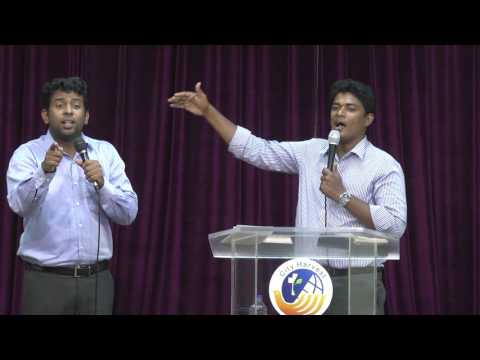
Study on Ephesians — Part 1
Paul's first prayer in Ephesians 1: for a Spirit of wisdom and revelation, to know the hope of our calling and that holiness is adoption into God's family.
I look up to your pastor here as one of the servants of God who serves this city with sincerity, and I am delighted to see how excited you are about God's word. In many of the places I travel to, people have no thirst for the word; but here I see a difference. I also noticed yesterday how much you value fellowship among yourselves. May God use this church powerfully in this city for the name of Jesus Christ. I sense God's presence here tonight in a powerful way — I am told you have been praying since five o'clock this evening, and I believe God will show up mightily through the ministry of His word.
Last evening we began looking at Ephesians chapter 1, from verse 17 onward, and since some of you have joined us new tonight, let me take five minutes to recap. Ephesus was one of the churches Paul himself pioneered, and he spent three years there — the longest he stayed anywhere, far longer than in Corinth, Thessalonica, or the other cities where he planted churches. In Ephesus stood a temple dedicated to the goddess Artemis; humanly speaking it was impossible to have a church in such a city. Yet because Paul arrived there in God's timing, God enabled him to establish one.
As you read Paul's letter to the Ephesians, it becomes clear that he is not satisfied with their present spiritual condition. He prays that their eyes would be enlightened, that they would be given grace to know the depth of God's wisdom and the depth of His love for them. In chapter 4 verse 14 he urges them not to remain infants, tossed back and forth by every wind of teaching. In chapter 5 verse 14 he cries, 'Wake up, sleeper.' Paul is writing with a burden.
Let me say this to you, brothers and sisters: fasting and prayer are an integral, essential part of the Christian life. We should be content with our material things, but we should carry a holy discontent for spiritual matters.
Two prayers of Paul are recorded in Ephesians — the first in chapter 1 from verse 17, the second in chapter 3 from verse 14. Tonight we are looking at the first. What is Paul praying for these believers, and what is the content of that prayer? This is a model prayer for all of us, because we have to learn how to pray. Many times we do not receive answers simply because we do not know how to pray; we ask wrongly, outside of God's will. Some preachers say you need not learn how to pray — you just go to your Father and ask for whatever you want. Yet when the disciples came to Jesus and said, 'Lord, teach us to pray,' He took time to teach them. So Paul's prayer here is a lesson for all of us. In this time of fasting and prayer, what should we — as a church and as individuals — long for?
Paul prays for two main things. First, in verse 17, that God would give them the Spirit of wisdom and revelation. Second, in verse 18, that the eyes of their heart would be enlightened. Now we must understand: these people already had wisdom. How do we know? Look at chapter 1 verse 8, where Paul says God lavished His grace on us with all wisdom and understanding, making known to us the mystery of His will. They already had wisdom and understanding — otherwise they would not have come to church at all. And yet Paul is not content with their spiritual state.
So it is with us. We are here this evening for fasting and prayer because we already have wisdom — we have received it. But we have come to pray for more: for a Spirit of revelation that can actually change our lives. Without it we come to church, listen to a sermon, go home, and nothing changes in the way we live. Only the Spirit of wisdom and revelation can change us.
His second request is that their eyes be enlightened. Again, their physical eyes were already open; Paul is not satisfied with that. It is the inner eyes, the eyes of the heart, that must be opened. What happens when a believer receives this Spirit of wisdom and revelation, when the eyes of the heart are enlightened? Paul says three major things follow — and that is where we stopped yesterday.
The first is this: you come to know the hope of His calling. Verse 18 says, 'I pray that the eyes of your heart may be enlightened, in order that you may know the hope to which He has called you.' As I said yesterday, many believers have no idea what the hope of God's calling is. Ask someone why they took baptism, and the answer comes: 'Because it is in the Bible, and my pastor told me to, otherwise I would go to hell.' Ask why they fast and pray, and they say, 'Something is hindering my blessing; I am fasting so that the obstacle will break and the blessing will come.'
I have discovered some of the real reasons people join a church. One person told me plainly, 'My son's wedding is coming up, so I need to get membership somewhere.' And we are happy, because another family has been added — but that person has no clue of God's purpose for his life. Here in Bangalore I recently heard another reason a man gave for choosing his church: because it had a good parking area. This is our spiritual state. This is our spiritual level. Most believers have no clue why God has chosen them.
Yet in chapter 1 verse 4 Paul says explicitly why we were chosen: 'For He chose us in Him' — that is, in Christ — 'before the creation of the world, to be holy and blameless in His sight.' Before the world was made, in Christ, God chose us. So which church should we go to and hold our membership in? Choose the church that values the word of God. I am glad you are here, because this church treasures His word.
But notice carefully those words: holy and blameless in His sight. In the tradition I grew up in, people defined holiness for themselves; we could present ourselves as very holy on a Sunday morning. I think that same pattern had crept into Ephesus — people wanting to appear holy and blameless before others. Out of that comes the attitude, 'I am better than him. Look at how decently I dress; I am better than he is.' Such people have no clue what holiness is. Remember the Pharisee and the tax collector? 'Thank God I am not like this man.' But the certificate of holiness must come from above — holy and blameless in His sight. God knows our thoughts, our motives, our purposes. People judge by actions: if someone comes early and arranges the chairs, we say, 'Brother, well done.' We judge by what we see, but God looks at the motive — why did you do it?
Even this evening, as I preach, I know that one day I must stand before the judgment seat of Christ. My preaching will not be judged by the quality of the points I share, but by my motive: what is my intention in sharing this? Is it to make you realize God's purpose for your life, or is it something else?
Now look at today's lesson, verse 5. Verse 4 says, 'He chose us'; verse 5 says, in parallel, 'He predestined us.' They speak of the same thing. But where verse 4 says 'to be holy and blameless,' verse 5 puts something else in that place: 'He predestined us for adoption to sonship.' So, brothers and sisters, what is holiness? It is being adopted into a new family. Holiness is about our relationship with God.
Christianity is not a religion with a set of rules — do this, don't do that, or else you fall. It is a relationship. Religion says, 'Do not do that; you must do this.' But Christianity is a relationship. Before the creation of the world God chose you and me, so that we would be adopted into His family. And out of that relationship we come to know what is right and what is wrong, and we fulfill the requirements of the law from the heart — not out of fear of going to hell, but out of love, to please Him. That is new covenant life: growing in our relationship with Jesus. The closer we walk with Him, the more holy and blameless we become.
Scripture has much to say about adoption. Look at Romans 8 verse 17: 'Now if we are children, then we are heirs — heirs of God and co-heirs with Christ.' This is why we need the Spirit of wisdom and revelation; only then can we grasp it. We are co-heirs with Jesus, which means whatever right Jesus has in this family, you and I have the same right. When Jesus prayed, the dead man Lazarus came out of the tomb — and you and I have been given that same authority by God's word. Jesus did His ministry by the power of the Holy Spirit, and we will be given the Holy Spirit in no less measure than He was.
You may ask, 'Pastor, then why is this not happening today?' The answer is simple: because we have not understood it. If in this time of fasting and prayer we will understand this and ask God, He will fill us with that same Holy Spirit. In Hebrews 2 verse 11 you read of this new family, in which Jesus is our elder brother, not ashamed to call us His brothers and sisters.
Adoption is mentioned in only a few places in the New Testament besides Ephesians 1:5. Let me point you to two: Romans 8:17 and Galatians 4:6, where Paul speaks of our adoption as sons of God. Turn to them and look for something they have in common. Do you see it? One word appears in both: Abba. Now, you know the New Testament was written in Greek and then translated into our languages — Tamil, Hindi, Malayalam, English — so we read many versions. But this word, Abba, is not a Greek word. Listen carefully: it is an Aramaic word. There is a perfectly good Greek word for it — Pater, 'Father' — yet in both these places Paul does not use it. He deliberately uses the Aramaic, Abba.
Why would Paul do that? I have thought about it. Anyone who reads the New Testament from Matthew to Revelation will quickly find the parallel — they will connect this Abba with another Abba. Where? In Mark's Gospel, chapter 14 verse 36. There, in Gethsemane, Jesus prays, 'Abba, Father, everything is possible for You. Take this cup from me; yet not what I will, but what You will.' Do you see what Paul is doing? Jesus called God Abba. And because we have been adopted into God's family, we too can call God Abba.
In the most difficult moments of your life, you can look up and say, 'Abba.' When you are hard pressed, when every door is shut against you, you can call Him Abba — and there is a heaven waiting to answer that prayer. He is looking for His children to come and call Him Abba. This is why Paul prays, 'Lord, give them revelation, give them the Holy Spirit, so that they will understand this.'
Many people who even speak in other tongues have not understood this. How do I know? Talk with them for ten minutes and every word is discouraging: 'I should have bought that plot twenty years ago — I wasted the chance. I should have taken that job; now what do I do? We should have agreed to the other marriage proposal.' I am not speaking of unbelievers; I am speaking of believers. Spend half an hour with such a person and you come away feeling frozen. I have experienced it many times — after half an hour I get up and say, 'Brother, I will pray for you, and I will leave,' because their stories leave me unable to help, and I myself walk away discouraged by their endless list of failures.
But hear what the Scripture says: nothing will happen to you outside of God's will. It is as simple as that.